Internet Time, anchored to UTC — the same @beat for everyone, everywhere.
The day has 1000 beats of 86.4 seconds. @000 is midnight UTC and @500 is noon — the same number at the same moment, wherever you are.
Convert
How @beat works
In a world of millisecond-precision chaos, we chose beautiful simplicity. One day, 1000 beats. No timezones. No AM/PM. No 'whose time is it?'
1000 beats a day
The day is split into 1000 beats — 1 beat = 86.4 seconds. Midnight UTC is @000, noon is @500.
No timezones
@523 means @523 for everyone on Earth. No conversions, no '2pm your time or mine?'.
Anchored to UTC
@beat time is a clean transformation of UTC — our servers stay tightly synced, so the beat you read is the beat that is real.
The Beat
Once a day, one moment for the whole planet — drawn provably from our sealed weekly root. It only works because everyone shares one time. In the app
On your watch
A real Wear OS watch face — a separate app on the watch itself, with 13 styles. Wear OS watch face
Beat handshake
Met someone? Two phones co-sign one @beat with device keys — the moment lands in the public proof log.
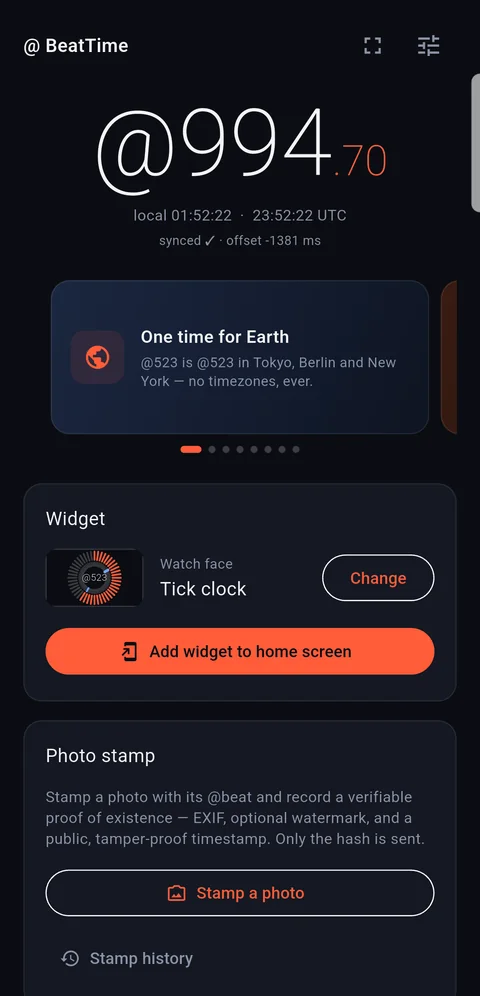
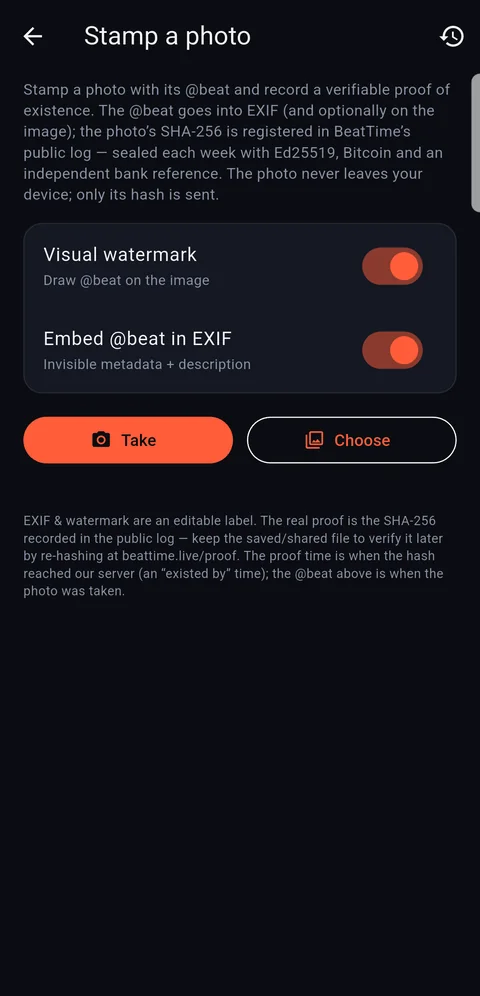
Put @beat to work
Free @beat clock for Android: 13 home-screen widget faces, a Wear OS watch face, a flip-phone cover clock, photo stamping and a converter. No ads, no tracking.
One global drop
Release music, posts or livestreams in a single @beat — your whole audience at once.
Embed the live clockTimestamp files & photos
One @beat, one hash — sealed in Bitcoin, a bank record and public archives, and checkable by anyone, without us.
Timestamp a file — freeWhere @beat comes from
On 23 October 1998, Swatch and the MIT Media Lab proposed one clock for the whole planet: Swatch Internet Time, 1000 beats a day with no timezones, counted from midnight in Biel (UTC+1). Our @beat keeps the same division of the day with a different midnight: UTC, the reference every server, satellite and network already uses — open and free, with a public API.
In a world of millisecond-precision chaos, we chose beautiful simplicity. @523 — no timezones, no confusion.
Swatch is a trademark of its owner. Sigelith is an independent project, not affiliated with or endorsed by Swatch.
FAQ
What is @beat time?
@beat time splits the day into 1000 beats (1 beat = 86.4 seconds), anchored to UTC. @523 is the same moment for everyone on Earth — no timezones.
How do I read @beat time?
Time runs from @000 (midnight UTC) to @999. Noon UTC is @500. Optional centibeats add two decimals, e.g. @523.45.
Is @beat the same as Swatch Internet Time?
The same division of the day — 1000 beats of 86.4 seconds — with a different midnight: UTC instead of Biel Mean Time (UTC+1). At any moment the two readings differ by 41.67 beats. Sigelith is independent and not affiliated with Swatch.
Does @beat time use timezones?
No. @beat is one number for the whole planet, so there is no whose-time-is-it confusion for remote teams.
Is there an app?
Yes — an Android app with 13 home-screen widget faces, a cover-screen clock for flip phones, photo and file stamping and a built-in converter, plus a separate Wear OS watch face. The clock works offline.